I used to think of outdoor lighting as a wiring problem. Trenches, conduit, an electrician on speed dial.
That's not really the case anymore. Solar lighting has quietly turned into its own decentralized, intelligent architecture — each fixture is basically a tiny independent power station, no cable run required.
The Bottom Line
Solar-powered lighting systems eliminate grid electricity costs, skip expensive cable trenching, install without an electrician, keep working during power outages, and meaningfully boost perimeter security — all running on clean, renewable energy.
Here's the reasoning behind each of those, with actual numbers.
Lowering Total Cost of Ownership

No More Monthly Utility Bill
A solar fixture works by converting sunlight into electricity through a small photovoltaic panel, storing that energy in a rechargeable battery, then releasing it through an efficient LED at night. Once it's installed, there's no meter running and no bill tied to it.
Across a property, switching outdoor fixtures to solar typically cuts outdoor lighting energy costs by around 30%, and that's before you factor in that solar fixtures have zero ongoing grid expense at all.
The Trenching Cost Reality
Traditional 120V lighting needs excavation, conduit, and a licensed electrician to legally connect it. That adds up fast, especially on larger properties.
Skipping that buried wiring typically saves somewhere in the $15 to $30 per linear foot range, plus whatever permitting fees you'd have paid on top of it. On a driveway or perimeter fence line, that's real money staying in your pocket instead of going into a trench.
Streamlined DIY Deployment

Zero Electricians Required
No high-voltage lines means no electrocution risk and no electrical fire risk from the fixture itself. That's what makes solar genuinely DIY-friendly in a way wired lighting never is.
Setup is close to as simple as it sounds: stake or mount the fixture, angle it toward open sky, and let the panel do its job.
Finding the Right Spot for Sunlight
Placement matters more than people expect. Aim for a spot with at least 6 hours of direct, unobstructed sun, and south or southwest-facing tends to catch the most consistent exposure through the day.
The most common mistake I see is tucking a path light directly under a heavy tree canopy. It looks fine in early spring, then summer foliage fills in and the battery starts running a chronic deficit.
Driving Decarbonization

Cutting Operating Emissions
Solar lighting runs on 100% renewable energy with zero emissions during operation — no fuel, no combustion, nothing burning to make light happen. For a household or commercial property trying to lower its footprint, outdoor lighting is one of the easier pieces to convert.
Reducing Light Pollution
Smart timer profiles and dimming schedules can scale brightness down during late-night curfew hours automatically. That cuts down on light trespass into neighboring yards and reduces sky glow, which matters more than people realize for local nocturnal wildlife.
Grid Independence and Resilience
Staying Lit Through Blackouts
Since each solar fixture stores its own power, a municipal blackout or a major winter storm doesn't touch it. Wired security lighting goes dark right along with everything else on that circuit; solar fixtures just keep running on their own stored charge.
Reaching Places the Grid Can't
This is where solar really shines for larger properties. Long driveways, agricultural land, remote construction sites — anywhere running grid infrastructure would be cost-prohibitive or just structurally impossible, solar can go there anyway. Comparing wired versus solar setups side by side makes this trade-off pretty clear.
Maximizing Safety and Security

Light as a Deterrent
Intruders generally prefer working in the dark. High-lumen solar illumination removes the blind spots that make a property an easy target, which is the whole idea behind crime prevention through environmental design.
Synchronized Perimeter Coverage
Modern solar fixtures can talk to each other over wireless RF linking. Instead of one isolated light flipping on in a corner, a single motion trigger can set off a chain reaction across an entire driveway or fence line, with each fixture syncing up within roughly 100 feet of the next.
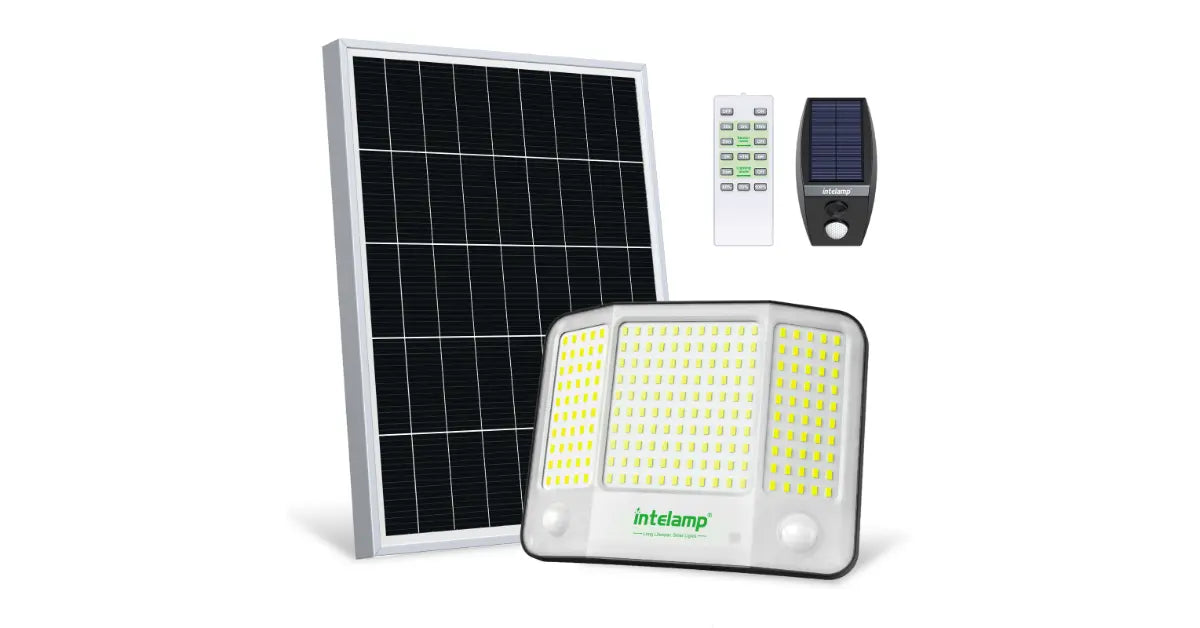
This is where the Intelamp 4000LM Linkable Solar Flood Light earns its place as a real benchmark for the category. It runs a 20,000mAh LiFePO4 battery paired with a 20W panel, fully recharging in about 5 hours of sunlight — enough for 2000LM of continuous lighting over 15+ hours, or 4000LM motion-activated brightness across up to 600 triggers.
The wireless linking works across up to 3 groups, so placing a sensor box near your gate can trigger the floodlights down your entire driveway before a vehicle even reaches the house. It's also built with a 210-LED array behind crystal-clear glass, an IP65 waterproof rating, a 16.4ft extension cable, and three switchable color temperatures — 6500K for security, 4500K for general activity, 3000K for a warmer garden feel — all adjustable through remote timer control.
Worth mentioning too: intelamp holds a Guinness World Record for the largest display of solar-powered LEDs, which is a decent signal of how much engineering actually sits behind fixtures like this one. If you're browsing for something in this range, our top-rated solar solutions collection is a reasonable starting point.
Advanced Materials: Why the Lens Matters

Tempered Glass vs. Plastic Resin
This one gets overlooked constantly. Cheap plastic lenses oxidize and haze over with UV exposure, and within about 2 years they can block up to 50% of the light that's actually reaching the ground.
Tempered glass resists that degradation almost entirely. A quality glass lens holds onto its clarity and light uniformity for well over a decade, so the brightness you paid for in year one is still mostly there in year ten.
Built for Real Weather
IP65-rated housing and industrial-grade materials keep fixtures functioning through heavy rain, humidity, snow, and freezing temperatures without the internal corrosion that kills cheaper units early. If you're specifically weighing performance in colder climates, how output holds up seasonally is worth a look before you commit to a location.
For a broader technical walkthrough of the underlying tech, understanding how these systems work is a good next stop. And if you're trying to figure out how bright you actually need to go, checking realistic lumen ranges will save you from over- or under-buying.
Frequently Asked Questions
What is the downside of solar lights?
The main limitation is that performance depends on direct sunlight exposure. Shaded spots, heavy winter snowfall, or a stretch of cloudy days can reduce charging efficiency and shorten nightly runtime, unless the fixture is paired with a sufficiently large battery and panel to buffer through it.
Why are people getting rid of their solar panels?
For whole-home solar installations, it usually comes down to the upfront cost of battery storage feeling too steep, outdated panel technology, lease agreement complications, or simply relocating to a new property. It's less common with standalone outdoor lighting, since the investment and complexity are much smaller.
Why is my electric bill so high if I have solar panels?
If a home solar system is grid-tied without its own battery backup, you're still pulling from the utility grid at night when panels aren't producing, often at peak rates. High household usage that exceeds solar production, cloudy stretches, and fixed utility connection fees can all keep a bill higher than expected too.
Are solar-powered lights worth it?
Generally, yes. The upfront equipment cost can run higher than a basic wired fixture, but you're skipping trenching, conduit, and electrician fees entirely. Combined with zero monthly utility cost and LED/battery components that can last 20+ years in commercial-grade setups, most solar lighting pays for itself well before that lifespan is up.