I like solar lights. They're low-maintenance, they don't need wiring, and they just work. But a story out of Tennessee made me stop and ask a question I hadn't really considered: can these little deck lights actually start a house fire?
The Bottom Line
Yes, solar lights can catch fire, though it's genuinely rare. When it happens, it's almost always tied to a failing lithium-ion battery, a missing safety certification, or moisture getting somewhere it shouldn't. The fixture itself is rarely the problem. The battery inside it usually is.
The Nashville Case That Changed My Mind

A Tennessee couple, Brad and Melissa, lost their entire home in about 20 minutes after a small decorative solar light on their back deck failed. WSMV4 in Nashville covered the story, and it's worth understanding because it's not a hypothetical. It actually happened.
The couple had picked up a cheap 10-pack of solar deck lights on Amazon. Fire investigators, along with an independent forensic team hired by their insurer, ruled out every other possible ignition source. What they landed on was a lithium-ion battery failure inside one of those lights.
Here's the detail that stuck with me: the product had no UL, ETL, or CSA certification. That means it was never tested by a recognized safety lab for things like overheating or overcharging. A $20 pack of lights, no warning label, and no oversight.
Why Lithium-Ion Batteries Are the Real Risk

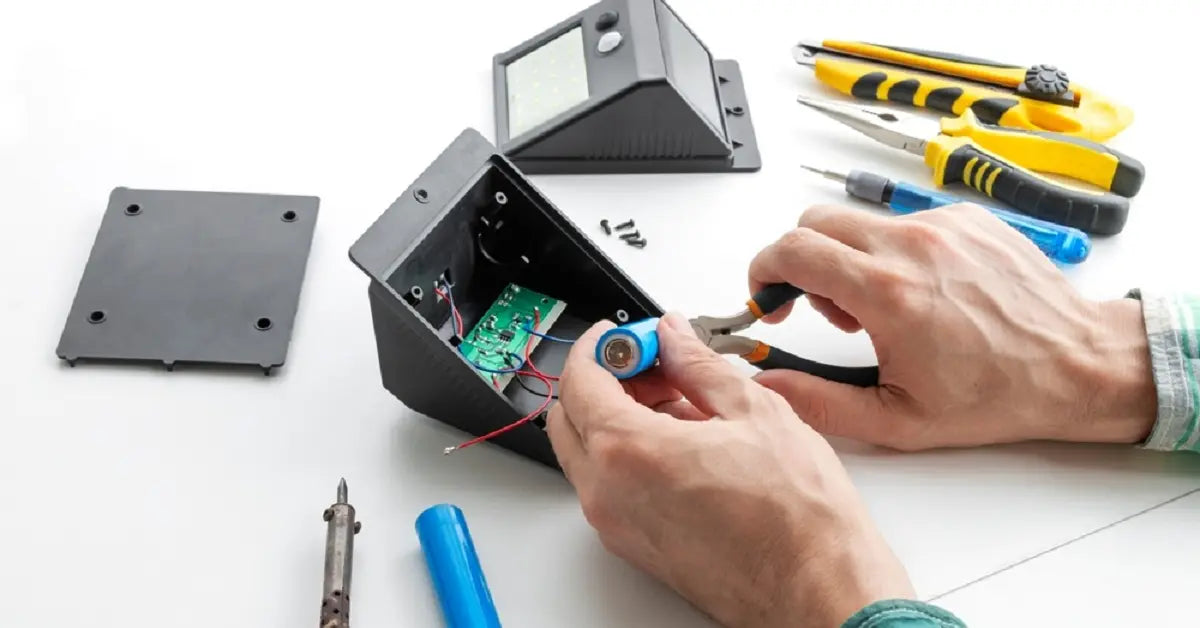
Most solar lights run on lithium-ion batteries because they're compact and powerful. That's also exactly why they need to be handled carefully. If a cell is defective or poorly managed, it can short-circuit and swell.
That process is called thermal runaway. It's basically an uncontrolled feedback loop of heat, and once it starts, it's genuinely hard to stop. A cheap casing can melt fast, and nearby wood, mulch, or siding can ignite in minutes.
Moisture Is the Other Half of the Problem
Rain shouldn't be a threat to an outdoor light. But budget fixtures with weak seals let water find its way to the internal circuit board.
Once moisture reaches those tiny PCB traces, it can bridge connections that were never meant to touch. That creates a short circuit, and a short circuit generates heat. Combine that heat with an unregulated battery, and you've got the exact chain of events fire investigators described in the Nashville case.
This is why preventing solar electrical hazards really comes down to one question: is the unit actually sealed against water, or does it just look like it is? A true IP65 rating means the housing keeps moisture away from the electronics entirely, not just most of the time.
What a Battery Management System Actually Does
Higher-quality solar lights include something called a BMS, or battery management system. Think of it as a safety controller sitting between the battery and everything else.
A good BMS constantly checks temperature and charge level. If the battery starts overcharging or heating up past a safe range, it cuts power before things get dangerous. Budget lights without one just let the battery charge unchecked, which is a big part of why solar lights fail so quickly in the first place.
Where You Mount the Light Matters More Than You'd Think

Even a well-built light can become a hazard if it's sitting directly against dry brush, mulch, or vinyl siding. That's simply fuel waiting for a spark.
A split-panel design solves this in a pretty clever way. You can mount the light fixture wherever you actually need it, and run the solar panel somewhere else entirely on an extension cable. That keeps the battery and the fuel source physically apart, which matters if something ever does go wrong.
Practical Safety Tips for Your Own Yard

A few habits go a long way here, and none of them take much effort.
- Do a quick visual check every so often. Swelling, melting plastic, or a burnt smell are all signs to stop using a light immediately.
- Only buy from brands that clearly list their battery type and show real safety certifications like UL, ETL, or CSA.
- Keep any solar fixture away from dry wood, brush, or siding, just in case.
This is the same reasoning behind the Intelamp Split Solar Security Light (1500LM, 6000mAh, White Light) (see it here). Its 9.8ft extension cable lets you place the fixture near your door or walkway while keeping the panel in full sun and away from anything flammable. It also carries an IP65 waterproof rating, so moisture isn't finding its way to the internal circuit board.
On the battery side, it runs a 6000mAh cell with smart discharge management built in, which is essentially a BMS by another name. That's good for over 12 hours of runtime or 300-plus motion triggers a night, with dual sensors giving you 270° panel coverage and 180° motion detection. Worth mentioning too: intelamp holds a Guinness World Record for the largest display of solar-powered LEDs, which says something about how these components perform outside a lab.
If you're weighing common outdoor lighting mistakes or wondering about leaving lights on all night, both are good follow-up reads once you've got the fire-safety basics down.
Frequently Asked Questions
Is it okay to leave solar lights on all night?
Generally, yes. Quality solar lights are built for dusk-to-dawn use. Just make sure they're certified and undamaged first.
Do LED lights get hot enough to start a fire?
Not really. LEDs run cool compared to older bulbs. When a solar light does cause a fire, the battery or internal wiring is almost always the actual cause.
Which solar batteries have caught fire?
Lithium-ion batteries are the main concern because of their volatile chemistry. Older options like Nickel Cadmium or Nickel Metal Hydride are more stable, though they don't perform as well.
Are outdoor solar lights safe?
Yes, when they come from a reputable manufacturer that uses quality parts and real safety certifications. The risk shows up with unregulated, too-cheap-to-be-true imports that skip the safety controller entirely.